International: ISO 21898 (General Technical Specification for FIBC), UN/DGFT (Special Standard for Dangerous Goods Transportation, if required)
Domestic: GB/T 10454-2021 (National Standard for Flexible FIBC)
Key Technical Indicators
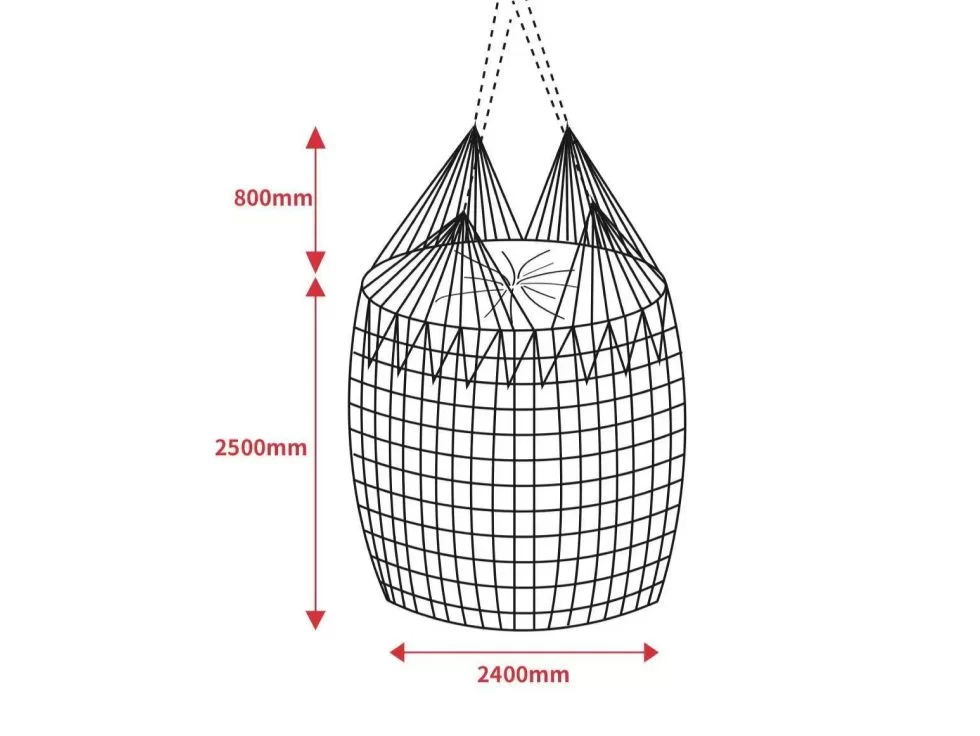
Load-bearing Performance: Rated load 15 tons, safety factor ≥ 6 (breaking strength ≥ 90 tons). The strength of top lifting, bottom lifting and side lifting shall pass actual test and verification.
Material Requirements: Base fabric adopts high-density polyethylene (HDPE) or polypropylene (PP) flat yarn, weight ≥ 240g/㎡, breaking strength ≥ 1800N/5cm (warp/weft direction); lifting belts adopt polyester (PET) or PP high-tenacity yarn, breaking strength of single belt ≥ 15 tons, quantity ≥ 4 (symmetrically distributed).
Structure Requirements: Multi-layer composite base fabric (inner leak-proof + outer wear-resistant) is adopted. Double-thread double stitching is used for bag body seams, stitch density ≥ 12 stitches/10cm, no skipped stitches or loose threads; equipped with leak-proof inner lining (film or non-woven fabric), dust leakage rate ≤ 0.2%.
Environmental Adaptability: Temperature resistance -40℃~80℃, UV aging resistance (strength retention rate ≥ 80% after 6 months outdoor storage), acid and alkali corrosion resistance (coating adapted according to loaded materials).
Core Production Process
Raw Material Preparation: HDPE/PP pellets → melt extrusion → yarn drawing → cooling setting → drafting → yarn splitting → winding (made into flat yarn).
Base Fabric Weaving: Flat yarn warping → rapier loom weaving (plain or twill) → base fabric heat setting (improve stability) → film coating (when leak-proof is required).
Lifting Belt Production: PET/PP high-tenacity yarn → twisting → braiding → heat setting → cutting (length adapted to bag body) → end hot-melt reinforcement.
Bag Body Sewing: Base fabric cutting (typesetting according to size) → sheet splicing (double-thread sewing on sides and bottom) → lifting belt positioning and sewing (reinforcement cloth added at joint with bag body, sewing length ≥ 10cm) → inner lining installation → top/bottom opening sewing (equipped with feed inlet and discharge valve).
Finished Product Inspection: Appearance inspection (no damage or skipped stitches) → tensile test (breaking strength of lifting belts and seams) → leakage test (loading simulation) → marking printing (rated load, material, safety factor, etc.).
Key Control Points
Flat yarn drafting ratio (1:6~1:8) to ensure strength, control weft density uniformity during weaving;
Lifting belts shall be sewn vertically to the bag body, reinforcement cloth covers the sewing area to avoid stress concentration;
Finished products shall be sampled for full-load drop test (no damage after dropping from 1.2m height) and stacking test (no deformation after stacking 3 layers for 24 hours).
Application Scenarios
Professional Packaging Solutions For
Dry/Bulk Container Cargos Of Worldwide